
About the craft
Types of Down Items and How They Differ
Let's go through the main types of classic down items and point out how they differ from one another. In essence, each of them is ideally suited to a particular…
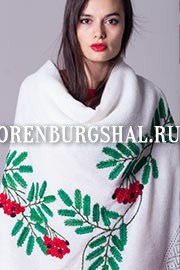
Let's go through the main types of classic down items and point out how they differ from one another.
In essence, each of them is ideally suited to a particular purpose. Some are warmer, while the main task of others is to show off a beautiful pattern and the knitter's needlework skill.
The main types of down items:
SHAWL, WARM SHAWL, GOSSAMER SHAWL, STOLE
DOWN SHAWL

Originally there was only one type of down item – the down shawl.
Historically, it was the ancestor of the whole future craft. The shawl is the core that combines the best properties of goat down and the knitters' skill.
It concisely combines warmth and beauty.
It is a fairly dense and warm item. It is made from thread on a cotton base with a high proportion of down. Thanks to this thread, the item is warm and hard-wearing. A shawl can protect you from severe frost and is almost windproof. Another feature of a shawl is that it has a pattern not only in the border but also in its central part.
That is, the shawl is the starting point for all other types of down items. It is warm and beautiful (with a knitted pattern over its entire area), and at the same time not very heavy, but not airy either. In a word, a shawl is a versatile item in which you will not freeze, and with which you can also amaze those around you with the beauty of its patterns.
Throughout the rest of the article, we will compare the other types of down items with the shawl.
WARM SHAWL

A warm shawl (shal), or warm platok, is the warmest of all types of Orenburg down items. The concept of the warm shawl appeared only in the 20th century.
Its main purpose is to keep its owner (and sometimes a male owner too – in frost there is no time for beauty and prejudice) warm in any cold. The item is so warm that it will easily protect you at -30 and even -35.
The basis for this is thick down thread on a cotton base and dense knitting. As a result, an item measuring 130x130 centimetres usually weighs 600–800 grams. Such a concentration of down guarantees that the warm shawl will not let you freeze in any weather.
The composition of a warm shawl is more modest than that of a shawl; usually the pattern is only on the edging and the border. Warm shawls can safely be considered the poorest in pattern, because their main task is usually warmth rather than beauty. But recently they too have begun to be decorated with complex, skilful patterns. Though, we repeat, the purpose of a warm shawl is warmth; a pattern along the border is usually enough, because the border is usually the only element clearly visible when it is worn. This is because a warm shawl is usually folded diagonally and worn on the head like a kerchief.
So, to sum up – a warm shawl is very warm, but you should not look for an elaborate artistic pattern in it.
GOSSAMER SHAWL

Gossamer shawls are also a new name in the classification of down items. Like the warm shawl, it came into use only in the 20th century.
A gossamer shawl is a fine, openwork down shawl. It is not as warm as its older brother, but its patterns are often a work of artistic craft.
Because the down thread is based on natural silk, it is very elastic, soft and silky. From this thread, craftswomen knit works of art distinguished by a variety of patterns, complex composition and an elegant look.
The gossamer shawl is the most beautiful and delicate of all types of down items. It is not as warm as a shawl, let alone a warm shawl, but its pattern usually surpasses all those listed above in beauty and variety of elements. However, you should not think you will be cold in a gossamer shawl. You can wear it even in bitter frost, and it will be much warmer than any knitted, or perhaps even fur, hat. Still, a warm shawl is better suited to severe frosts.
So, a gossamer shawl is always beautiful and airy, but not as warm as a shawl.

STOLE

The stole is a completely new concept in the practice of Orenburg down knitting. Stoles appeared only in Soviet times. And they arose not even as a tribute to fashion, but as a by-product of working-hour quotas.
Knitters who knitted gossamer shawls were often set knitting plans for a certain period of time. And to optimise the process and production time, so-called "halves" appeared. This term meant half of a gossamer shawl. A rectangular shawl that later came to look more and more like a scarf.
In its properties, a stole is the same gossamer shawl, only rectangular rather than square. That is, a stole is a light, warm down scarf with a beautiful composition of patterns.
One of the main advantages of a stole is its compactness. Such a scarf can be taken almost anywhere; it will not burden its owner and will easily fit in a handbag.
So, a stole is a rectangular gossamer shawl, a convenient and practical accessory that does not take up much space and is warm enough to protect even from severe frost.
To sum up, it is also worth noting that the differences lie not only in the appearance and properties of the items: usually different down items are knitted by different people. That is, if a craftswoman knits warm shawls, she will not be able to knit a gossamer shawl as skilfully. In the Soviet artels, craftswomen were officially divided into "platoshnitsy" (those who knitted warm shawls) and "pautinishnitsy" (those who knitted gossamer shawls and stoles). This confirms once again that the ability to knit each type of down item is a special art requiring many years of practice and talent.
Recently, new types of down items have also appeared – ponchos, pelerines, cardigans, snoods, hoods and many others. But since they are more a response to fashion trends than classic Orenburg items, we will look at their differences in other articles. We will only note that all of them are presented on our website.
Need help choosing?
Tell us who you are choosing an item for and what matters to you — warmth, lightness, size or pattern. We will suggest suitable options.


