
About the craft
Combing Goats
How is goat down obtained? When and how many times are goats combed? Which down is considered the most valuable? Are there reasons not to comb goats? Our article is devoted to the answers to these questions.
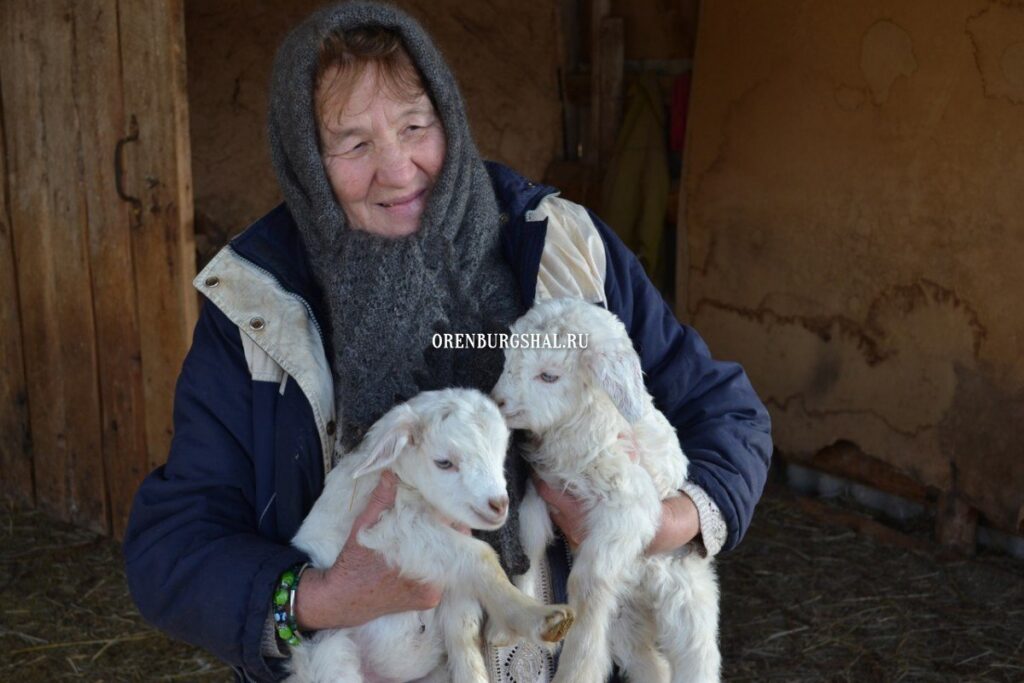
The down of Orenburg goats is a completely special kind of raw material. It is finer than the wool of merinos, the finest-fleeced sheep. And what light, elegant and warm shawls are made from goat down!
How goat down is obtained
The raw material for making Orenburg down shawls is obtained by combing out goats. This process is quite long and very labour-intensive. It is also important to time the combing so that the goats have started to moult but the down has not yet had time to mat. According to our experienced goat breeders, the best time to comb goats is the end of winter – beginning of spring. Goat breeders periodically check whether the goats are moulting. To do this, they make a parting in the fleece with a comb and touch the hair by hand, and if the down sticks to the hand and comes away easily, it is time to start combing! After all, only by catching this exact moment can you win in both the quantity and the quality of the raw material at once!

When goats are combed
By the way, the goats are combed twice, with an interval of about 15–18 days. February down, from the first combing, is considered of higher quality. It contains practically no debris, impurities or stiff, prickly guard hairs. The thing is that after the first combing some down remains on the goats in places, and during the second combing the remaining down comes away perfectly from the back of the head, the neck, the spine and the thighs. There is also an order in which goats are combed. First come adult castrated animals, then the young ones, then breeding bucks and does. But pregnant does are not combed at all, or it is done very, very gently. Incidentally, a direct link has been established between the age of goats and the quality of the down. It is recommended to take down from goats up to 6–7 years old. After this age, the down loses quality.

What goats are combed with, and how
Goats are combed out with a special comb. It looks like a wooden shovel with many metal teeth shaped like hooks. Combs come in two kinds: some for preliminary combing and removing debris from the fleece, and others, with closer teeth, for combing down from the goats. It is important to comb goats correctly – from the back to the belly along the sides, then the belly itself. You must not press too hard, as there is a risk of damaging the goat's skin with the comb.

Preparing for combing
For 12 hours before combing, the goats are not fed or watered – these measures help keep the down dry and relatively clean. A room is prepared separately for combing, the floor is covered and mats are prepared. Three of the goat's legs are carefully tied together, and it is laid on each side in turn. When all the down has been collected from the goat, it is untied and released into its stall. Already during combing, experienced goat breeders sort the down by both colour and quality.

And only after repeated processing does the raw material obtained from combing turn into down thread, from which our very legendary down shawls of incomparable beauty and the highest quality are knitted.
Need help choosing?
Tell us who you are choosing an item for and what matters to you — warmth, lightness, size or pattern. We will suggest suitable options.


