
About the craft
Which Is Better: Fully Handmade Down Items or Those Made with a Hand Knitting Machine
By method of making, handmade Orenburg down shawls come in two kinds:
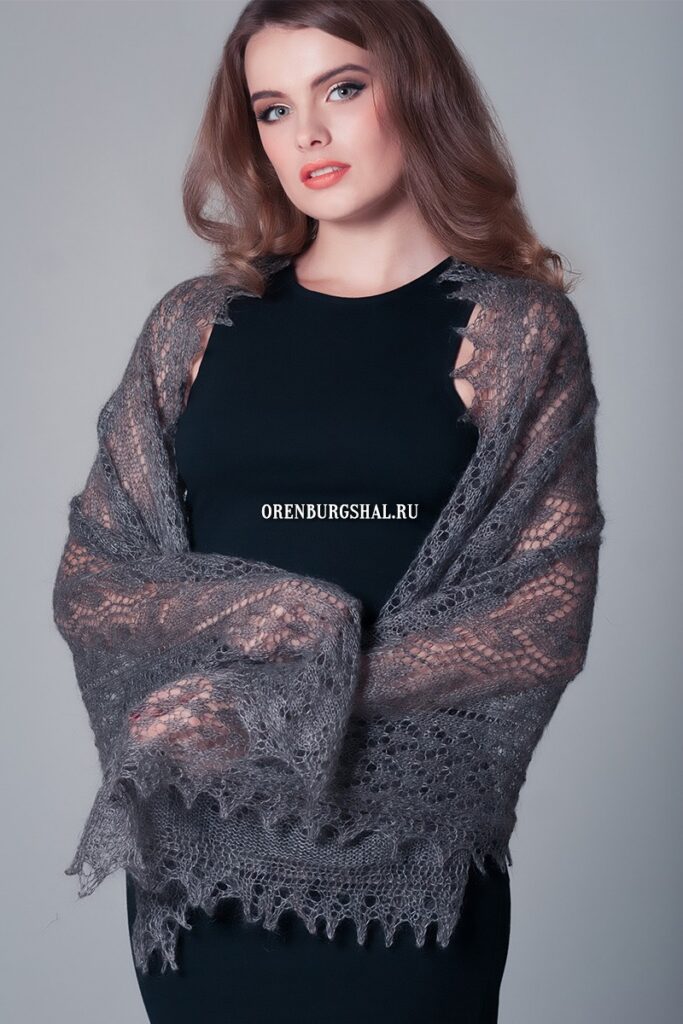
Still, our staff decided to compare, by experiment, fully handmade items and items made partly by machine knitting. Two stoles differing in their method of making were chosen for the experiment. The items were worn for two and a half months. Various factors were taken into account, including potential mechanical wear, possible "fading" of the item, "fluffing" of an initially smooth item, down shedding and leaving traces on clothing, as well as the general impressions of the staff members conducting the experiment from "interacting" with the down item.
Fully handmade stole


A grey item, initially smooth. In the course of wear, slight "fluffing" occurred within the first two weeks (the item was worn actively, on average up to 4 times a week, in effect being an everyday item of clothing).
The staff member's impressions of using the item during the set period are as follows:
- initially the stole was completely smooth. The item began to fluff after approximately 2 weeks. During the process, the stole left practically no traces on clothing;
- the staff member had no complaints about prickliness throughout the experiment;


- no fading occurred within the set period; when not in use, the item was stored in a desk drawer in a "zip bag";
- the item was stored and used in accordance with the precautions described in the relevant article, so it suffered no mechanical damage. So-called "stretching" and possible changes in the item's size did not occur either.


Stole knitted using a hand knitting machine


A white item. As with the fully handmade stole, initially completely smooth; according to the staff member, "slightly denser to the touch". The conditions and frequency of wear, storage and care were the same as in the first case. The results of the experiment are as follows:
- the smooth item began to fluff during wear after 3 weeks of use. There was minimal shedding of down onto clothing, but after the shawl was hung out in cool air and then "shaken out", the process stopped (the measures are described in detail in the relevant article on our website);
- the staff member had no complaints about prickliness, but comparing the staff members' general impressions (including the exchange of impressions after the experiment), the fully handmade stole is noticeably lighter and softer to the touch and in wear.


- no fading occurred during the entire experiment;
- after 2.5 months of active use, including storage and hanging the item on a frame (in order to stop even minimal down shedding), the stole "stretched" slightly, specifically, the item's length increased within an acceptable tolerance (up to 10 cm).


The staff members' general impressions of using both items are mostly positive.
Based on the results of the study, the following conclusions can be drawn:
- Orenburg down items, both fully handmade and knitted using a hand knitting machine, equally have the right to be called genuine. Neither of the chosen stoles caused major problems during wear.
- naturally, the price of items knitted using a hand knitting machine may be lower than that of fully handmade products. At the same time, partial machine knitting does not indicate low quality of the item offered, so it is important to understand that such shawls, warm shawls, gossamer shawls and stoles also have every right to be called genuine Orenburg ones. However, the highest quality and the absence of even the slightest possible complications associated with active use are achieved precisely in fully handmade down shawls.
Need help choosing?
Tell us who you are choosing an item for and what matters to you — warmth, lightness, size or pattern. We will suggest suitable options.


