
About the craft
Why Is Down Knitting of the Orenburg Region a Unique Phenomenon?
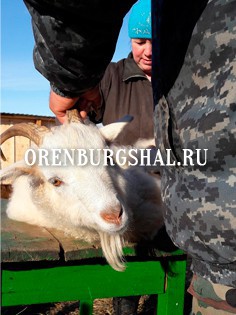
As is well known, Orenburg down shawls are knitted from the down of goats of the same name. In our previous articles we have already said that the Orenburg goat is a special selectively bred type, a direct descendant of Kashmir goats, which did not appear without human intervention. It is from their special undercoat, which forms naturally, that the main material for making down items is obtained, and it is the type of raw material that plays one of the decisive roles in whether a shawl in front of us is an Orenburg one or not.
Indeed, the claim that Orenburg shawls are knitted only in Orenburg is a common and mistaken stereotype. It has long been known that the key points here are the raw material and the making technology. We also know that in the 19th–20th centuries Orenburg handmade was at the peak of its popularity, and this popularity, fortunately, is gradually returning now. The question arises: if the place where an Orenburg down shawl is actually made is not a decisive factor, why has no one set up their mass production in other regions? Did no one even try? Of course they tried. The question is: what got in the way?


To best understand the situation, it is worth turning to history and geography. Historically, Russia had only three large, long-established centres of down goat breeding and down knitting: the Prikhoperye area of the Volgograd Region, the Altai Mountains and, of course, the Orenburg Region. If we compare these three regions, we will see a roughly similar climatic picture. Moreover, while the climate of the Volgograd Region can be described as moderately continental (fairly cold winters with frequent cyclones and moderately hot summers), the Orenburg Region and the Altai Mountains are distinguished not only by a sharply continental climate but also by features of the terrain which together create sharp temperature differences (very cold winters and very hot summers). These weather features instilled in down goats a genetic "habit" of storing up an incredibly warm down undercoat in winter and trying to shed it in spring as unnecessary, since at high temperatures from late April to mid-September it would only cause the animal discomfort and inconvenience. In fact, combing out the undercoat can be seen not only as a way of obtaining raw material but also as help for the down goat: combing the down is considered a mandatory procedure in this respect; if it is not done, you can see the animal rubbing intensively against various objects, trying to "shed" the bothersome undercoat on its own.


Why, in the end, did the Orenburg Region in particular become the main centre of down knitting? Besides the sharply continental climate, the geomorphology of the region plays a big role. The low-mountain landscape of the Ural range and the vast syrts crossed by rivers create almost ideal conditions for natural pastures over huge areas, which makes it possible to keep and efficiently use a large herd of down goats.
The combination of the two factors above is a necessary condition for forming a down-knitting craft on an industrial scale. And this "ideal combination" is characteristic precisely of the Orenburg Region.


Now about the attempts at mass breeding of down goats in other regions. Of course, such attempts were made repeatedly, and far from recently. It all started back in the 19th century, when, thanks to various exhibitions and trade routes, the fame of the Orenburg down shawl spread far beyond the Russian Empire. Entrepreneurs from different corners of the world saw in the down-knitting craft the prospect of an efficient business. At first they began buying Orenburg down directly from the Region. Naturally, this approach could not provide the desired scale of production, and Orenburg goats began to be taken abroad. Attempts to breed this breed were recorded in France, England, Holland and even a number of South American countries. The goats adapted fairly well to the new conditions, bred willingly and... lost that very highly valued undercoat within 2–3 years. The climatic conditions simply did not match those required, and in the end the goats began producing down no different from that of any other breed. To put it very bluntly, in a sense they stopped being Orenburg goats.


Enterprising colleagues from other countries eventually had to return to the previous stage – buying down directly from the Orenburg Region. Naturally, there could be no question of an industrial scale in this case.
Judging by the recorded historical episodes, it was the climate that played the key role in the Orenburg Region remaining the main and largest centre of down knitting, and in Orenburg shawls in particular enjoying such fame. Perhaps somewhere the opposite situation may have occurred: an almost perfectly suitable climate, but no vast areas fitting the definition of natural pastures. There are no recorded cases in the historical archives.


What can be said about today? From the point of view of whether attempts at large-scale development of a down-knitting craft replicating the Orenburg one make sense, the picture has hardly changed. The Orenburg Region was and remains practically the only place in the world with ideal climatic conditions for forming that very special down undercoat. Even if we talk about the possibility of artificially creating conditions close to those required (which in itself is incredibly expensive), there would hardly be enough resources to create the necessary areas to accommodate such a herd of these unique animals.
For this reason, the Orenburg down-knitting craft was and remains a unique, historically and geographically formed phenomenon, and Orenburg goats themselves are a relict and specially protected type, the loss of which would be an irreparable loss not only for our region but for the biodiversity of the Russian Federation as a whole. Fortunately, given the humane way the raw material is obtained and the special protected status, they are not in danger of extermination today.


The facts above show once again that the Orenburg Region is the only place with ideal conditions for a strong and dynamically developing down-knitting craft. In other regions of the country and the world, for a whole range of natural and economic reasons, such a craft simply cannot function on the same scale and be the actual "calling card" of the region.
For our part, we hope that down goat breeding and the knitting of Orenburg down shawls will continue to move towards stable and comprehensive development, and, as a fully-fledged down artel, we will make our own contribution to the unique craft of the Orenburg region.
Need help choosing?
Tell us who you are choosing an item for and what matters to you — warmth, lightness, size or pattern. We will suggest suitable options.


