
About the craft
Japanese Young People Want to Knit Orenburg Shawls
The question of reviving interest in the Orenburg down shawl is more pressing today than ever. We are especially concerned about the future of the craft – not the nearest future (for now, fortunately, there is positive momentum), but the long-term outlook. What will become of one of the most important crafts of our region in, say, 20 years? After all, despite every effort, it has not yet been possible to "rejuvenate" down knitting on a large scale. In the Orenburg Region, even among the daughters and granddaughters of hereditary craftswomen, the share of those who want to take up knitting goat down items seriously is critically low. But here is a question: can people not just from another country, but from another culture, be won over by this art? The heroines of our report are the answer to this question. Yes, they can.
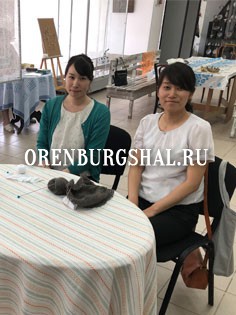
Japan is known all over the world as a country of punctual and hard-working people who prefer to see through any task they take on. As we know, down knitting is a long, painstaking process that requires perseverance, attentiveness and patience. And these are exactly the qualities the people of the Land of the Rising Sun are famous for. These qualities helped Tomoko and Nozomi master and fall in love with the process.


The young women came to Orenburg to teach Japanese to those who wished to learn it (Tomoko about two years ago, Nozomi somewhat later). The classes, by the way, are held at the Centre for Japanese Culture at Orenburg State University and, according to Tomoko, the students are making progress (for our part, we would add that the young women's knowledge of Russian is impressive too). Tomoko first learned about the Orenburg down shawl from open sources and became very interested in the leading craft of the place where she lives (even if temporarily).
- I learned about Roza Sakhabovna's courses and really wanted to learn, - she says, - so I came to the "Orenburg Down Shawl" gallery.
Roza Sakhabovna Gumerova is known in the Orenburg Region as a hereditary craftswoman and one of the best teachers of down knitting. It was she who took Tomoko (and later Nozomi) under her guidance and built the whole learning process.


- The Kombinat used to make fairly large deliveries to Japan, - says Roza Sakhabovna, - mostly there was interest in stoles (they appeared in the 1970s). They were not only sold there; large craft exhibitions were regularly held there, including of Orenburg down knitting.
When we asked about the current state of affairs, Roza Sakhabovna, Tomoko and Nozomi all answered that at the moment exhibitions are hardly ever organised, and the price of a down shawl in Japan (if you can find one) is prohibitively high. Meanwhile, Tomoko has already bought down items in Orenburg for all her relatives and given them as presents. According to her, the gifts were liked, and very much so.


Tomoko and Nozomi do not yet have finished items made with their own hands, but they have works in progress, which they agreed to show. The quality of the work really managed to impress even our staff, who have seen many thousands of the most varied items in their time. Roza Sakhabovna's talent and professional skills, together with the diligence of her students, are doing their job.
Tomoko and Nozomi's approach to creating their future items is no different from that of the best craftswomen we have had the chance to talk to over the years of our work. Every single loop is checked in the process; if there is a mistake, it is unravelled and everything starts over.


(Note: these are exhibition samples from the Gallery. In the photo on the right is Tomoko and Nozomi's favourite shawl, knitted by Roza Sakhabovna. When we asked about the item they liked most, the young women unanimously pointed to this one).
Today in Japan there is practically no understanding of what an Orenburg down shawl is. However, our heroines have clearly been won over by the culture and craft of the Orenburg region and promise to tell people about it in their home country. At the very least, the process itself gives Tomoko and Nozomi a great deal of pleasure, and they plan to continue with it in future.
We note that what Tomoko and Nozomi say about the emotions that down knitting brings is practically no different from the stories of our craftswomen.


Nozomi will leave Russia next week. According to her, she will keep the warmest memories of our city, and perhaps one day she will visit Orenburg again. Tomoko also stresses the friendliness and openness of our people. She, by the way, married a man from Orenburg and even gave birth in our city (for ethical reasons, the names of her family members are not disclosed). She plans to stay here for the coming year; returning to Japan is a matter of time, but the question remains open for now.
- I plan to stay here for the coming year, - says Tomoko.
And that means that in some time she will finish her first masterpiece, and of course we hope to see it and even show it to our readers.


It is worth adding that Tomoko already knew how to knit when she came to Roza Sakhabovna (she only had to learn down spinning from the very beginning). Nozomi came later and learned practically everything from scratch (at that time she could not knit). And, it must be said, she has also achieved serious results.
At the end of this article we would like to address young people, especially, of course, the descendants of down-knitting craftswomen, those for whom the Orenburg down shawl evokes only a condescending smile and a complete unwillingness to take over the skills of their mothers and grandmothers and preserve this great craft: if even people from another country, another culture and another view of the world have been won over and want to bring our craft to the public, do we have the moral right to simply turn our backs on what was created over centuries? After all, respect for oneself and one's home begins with respect for one's own history and culture. We once again call on everyone who cares not to turn away from the possible problem of the decline of artistic crafts, and we keep the hope that we will be able not only to preserve the down-knitting craft of the region but also to take it to a qualitatively new level, largely thanks to people like Roza Sakhabovna, who is ready to pass on her unique skills to anyone who wishes, and Tomoko and Nozomi, who are ready to bring a piece of our culture into their own.
For everyone who has become interested, we would like to let you know: the "Orenburg Down Shawl" gallery holds weekly training courses by the best teacher in the Region. For a moderate fee, absolutely anyone can learn in a relatively short time to create masterpieces of the Orenburg down-knitting craft on their own. And, who knows, perhaps you will build a career as a professional craftswoman (which is not only prestigious but also quite profitable) and become the future of the whole craft.
Need help choosing?
Tell us who you are choosing an item for and what matters to you — warmth, lightness, size or pattern. We will suggest suitable options.


