
What does the Orenburg down shawl mean to you?
We are sure that for most people the answer to this question will be: an accessory for grandmothers, which everyone learns about from their stories. Some will say that it is a symbol of the Orenburg Region, the very souvenir that everyone feels obliged to bring back from Orenburg when here on a business trip or for any other reason. But there are also those who, having received an Orenburg down shawl as a gift, or having bought one, become owners of a genuine, quality item. Not just a warm shawl, but a lifelong talisman. Every stitch and the warmth of such a shawl connect generations; it is passed from mother to daughter and loses neither its shape, nor its relevance, nor its valuable qualities.


The service life of a genuine down shawl, with proper care, can be 100 years or even more, as historical facts eloquently testify. Right now you are probably frowning in disbelief and thinking that we are attributing far too incredible properties to such a seemingly simple item of clothing. But believe us, we know what we are talking about. And we will gladly reveal to you all the secrets of the magical aura surrounding our Orenburg down shawl.
There is nothing more natural and durable than what nature has created.
Let us start with the service life of our down legend, which is measured in centuries. The main guarantee of a down shawl's durability is its naturalness. The shawl is knitted from down and a base — silk, cotton thread or viscose. You will say: down is down even in Africa, what is so special about it? But the down of Orenburg goats really is unique. It is very fine (15–17 µm) and quite long (60–80 mm), elastic, strong (much stronger than wool), and felts little. It is thanks to this that down products are so soft and pleasant to the touch.

A.I. Erokhin, V.V. Sokolov, G.A. Kuts, V.D. Khromchenkov, V.I. Zadumina. Goat Breeding: A Textbook. Mother Nature endowed the down of our goats with such properties for a reason. In the conditions of the fierce steppe Ural winter and the scorching summer, it is not easy to survive without the right coat, and without shedding it in spring.

Note that it is not only animals that are tested by our harsh climate, but people too! In Soviet times Orenburg had a legendary flight school (the Orenburg Higher Military Aviation Red Banner School of Pilots named after I.S. Polbin)), whose graduates included hundreds of Heroes of the Soviet Union, among them Yuri Alekseyevich Gagarin. The country's leadership placed this educational institution precisely in our harsh climate, where the annual temperature range is almost 100 °C. It was in such conditions that the character and courage of heroes were tempered.

It is in this climate that the secret of the unique properties of the down and the shawls knitted from it lies. The harsher the environmental conditions, the more concentrated the properties with which nature endows the fur of animals to compensate for the negative factors. The goats of our Orenburg steppes are not large, but they will endure frosts and cold that would be fatal for any other goat.
Without harm or pain
Not only the harsh winters in our region, but also the summer heat can compete in its intensity with southern cities. Few people know that the real watermelon capital of Russia is a small town 70 km from Orenburg — Sol-Iletsk. You must agree, it is quite a unique combination: in winter our goats grow the warmest down because of the unbearable cold, and in summer there is always the biggest harvest of melons and watermelons because of the scorching sun.

So as not to boil in their own coats in the warm season, goats begin to moult between February and March. It is at this time that they are actively combed. This process is very laborious and long. Everything is done exclusively by hand, using special combs.


After combing, only the hair remains on the goats; almost all the downy undercoat comes away and becomes the most valuable material for making yarn. Thus the whole process of obtaining down is absolutely painless and, moreover, by taking the down, a person helps the goat get rid of its warm coat sooner, which in summer would be fatal for the animal. Why are we describing the process of obtaining down in such detail? Because even the main material for making a shawl is not a product of death or violence, but a mutually beneficial symbiosis based on love and care, in which a person helps the goat give up what it no longer needs and uses it for their own good. And in every item you can feel that very warmth, care and love. Wrapped in a shawl, you no longer want to hurry anywhere; you want to enjoy peace and comfort. It feels as if it is not just a shawl, but the embrace of your dearest person, in which you want to stay longer. Note that only strong, LIVE down has unique properties. If down is taken from a dead animal, a quality shawl can no longer be knitted from such material. You cannot cheat nature. What other warm item can boast such a biography? Perhaps an expensive mink coat? We doubt it… By the way, good fur also comes only from live animals.


Not magic, but the nature of the material and the technology of handmade production
But why do we talk about decades of wear? We have already said that Orenburg down is very fine and elastic. It turns out that if you take two down yarns of the same thickness, the one spun from Orenburg down will contain many more fibres and will be practically indestructible.


Down yarn is quite thick. Its thickness is about 1 mm (photo of the yarn), while the thickness of Orenburg goat down is only 14–16 microns. That is, a 1 mm yarn contains about 70 down fibres. Whereas, for example, a yarn of Pridonsky (Volgograd) down contains only about 40 fibres. As they say, feel the difference.


The spinning process is very long and requires not only patience but also skill. The yarn obtained from down is extremely strong (the breaking load of down fibres is 8.2 kg). But that is not all. For even greater practicality, the down yarn is combined with a cotton or silk thread by twisting, almost like a braid. This process is called plying. After this the material is about 1.5–2 mm thick and ready for a long and useful life as a down item. Note that all the processes described above — from combing the goats to obtaining a finished down item — are manual labour. And that means not hours, but days and weeks of painstaking work.
And now a little magic
Who can knit a shawl that spreads intricate, complex patterns across the entire fabric? This skill does not come quickly; it takes many years for a knitter's hands to become, as they say, golden. Only great talents can master this craft to perfection by the age of 30–40. Most often, works of art come from the needles of knitters at the age of 40–50. These hard-working women spend their whole lives working with down and needles. For them it is love and their life's work. You must agree that no amount of money could make a person devote themselves so selflessly to work they do not love for half a century. There are no random people in down knitting. As a rule, they are hereditary knitters. Those who do not take to this hard work leave the craft immediately. For others it becomes their life's work. We call such people people with a down heart — soft, warm and kind. There is so much light and love in them that even putting a piece of their soul into every item, they only become richer! These women cannot imagine their lives without their beloved craft. Without what warms their soul and brings joy to those around them.


It is in such hands that the precious down of Orenburg goats turns first into a warm, strong and reliable yarn, and then, with the help of knitting needles, takes the form of soft gold.
How quickly is a shawl knitted?
How long does it take to create a down shawl? If we start from its origins, we must go back to the down. On average, one goat gives 300–500 grams of down a year. A shawl of 120 centimetres or more usually requires about this amount of down. That is, to knit one shawl, you need to look after one goat for a year. It is worth noting, though, that goats are quite undemanding animals. And they are very clean. So they are much less trouble than, say, cows. And people usually keep not one goat but several at once, but still, just imagine that for a whole year you have to look after an animal and wait for it to give its fleece.


Between February and March (usually mid-February to early March) the goats are combed. On average, combing one goat takes 4–8 hours depending on its size and the amount of down.


Then comes the process of preparing the down. Foreign bodies are removed from it; it is washed several times, dried, the guard hair is picked out, and it is combed on combs or carding machines to get rid of down clumps. This process is very long and requires enormous patience and perseverance. Preparing one kilogram of down for knitting takes at least 15–20 hours of continuous work.


After the down is prepared, down yarn is spun from it and twisted with a base (silk for gossamer shawls or cotton for shawls). We will not describe this process in detail; you can read about it here. The time it takes to make 300–500 grams of finished yarn is about 20 hours.


The knitting process. Here a lot depends on the knitter's skill and experience. On average, knitting a shawl from the prepared yarn takes 90–270 hours. (about 2–4 weeks). After that the shawl must be washed again and stretched on a special frame, which also takes from 2 to 3 hours. And then you wait until it dries and takes shape.


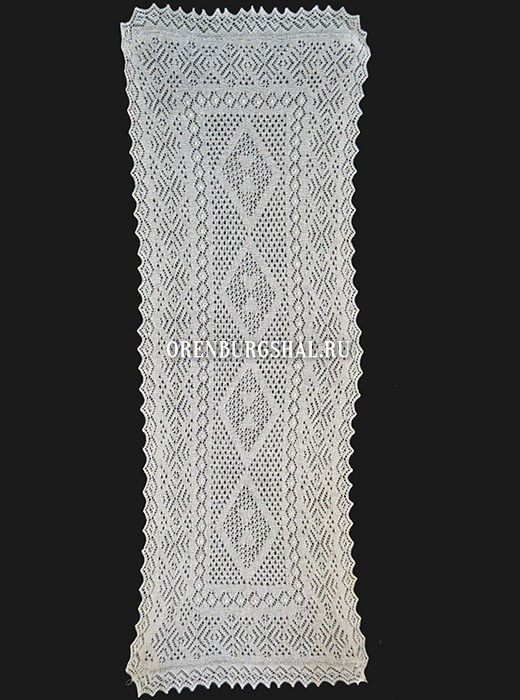
In total, depending on the complexity of the item, it takes a knitter from 112 to 292 hours to make ONE shawl. During these long hours of painstaking and diligent work, when the shawl gradually turns from a shapeless mass of down into a warm miracle, when the knitter creates a lace story with her own hands, real magic happens.

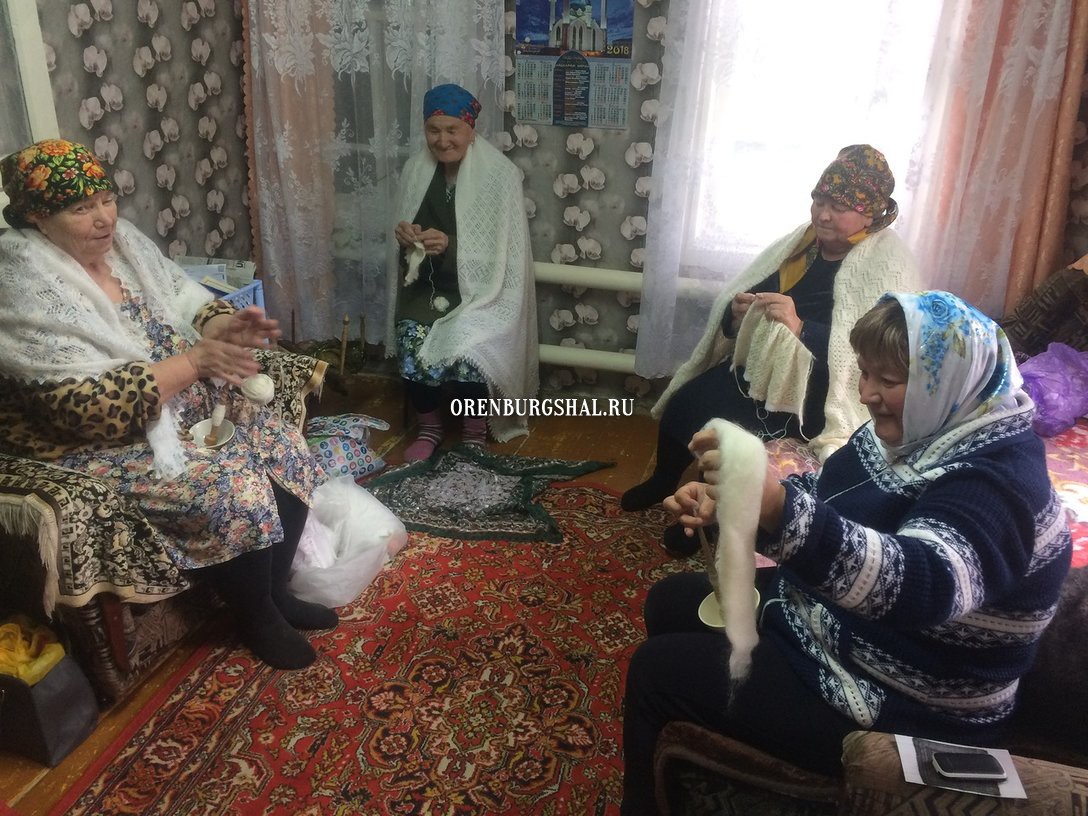

Together with the hours of jewel-like work, the shawl becomes a mirror of the souls of these seemingly ordinary, yet at the same time great people, who hold in their hands the experience of generations and the fate of a great craft. And these people really are great. Quiet workers with interesting fates worthy of historical novels. They went through trials that would break any of today's ordinary people. And only work and devotion to their craft were their support and constant companions in life.
A family talisman. From generation to generation
Our website has hundreds of reviews from customers sincerely amazed by the Orenburg down shawl. They express gratitude to the knitters and admire their work. But all these people are only at the very beginning of a long warm journey. Our main goal is to revive old Russian traditions, or more correctly, to remind people of them.

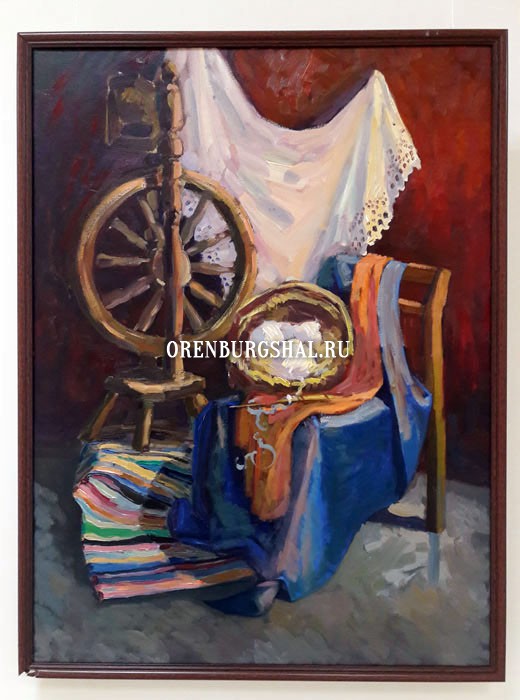

For almost three centuries now, the Orenburg down shawl has been a symbol of female and maternal warmth for many families. The shawl warmed a woman in her maidenhood, when she attracted men's glances, and always emphasised her beauty and modesty. The intricate patterns of the border amazed, and the dense warm texture earned the respect of knowledgeable people. The girl married, gave birth to children, and wrapped newborns and toddlers in her shawl. The shawl now warmed the woman-mother in the cold and protected her from the deceptive spring wind. Women also worked in it, going both to the factory and to the harvest. In the evenings they wrapped themselves in the shawl while reading books to their children.


The shawl was used as a cover during illness and tied on when one needed to warm up and get through an ailment. When the children grew up, the shawl passed from mother to daughter. In the new family it kept the warmth of mother's hands. It was darned and mended and worn until it was full of holes. From a festive garment, the worn shawl turned into part of the family altar. New generations were born, and grandchildren were wrapped in the old, worn shawl in which their grandmother had once shown off. But the grandchildren always treated the warm and dear shawl with respect and love; they remembered it from long winter walks in a sledge or pram, tied over a hat or under a fur coat; they remembered how mother or grandmother covered them with it on cold winter evenings, or how they woke up after a night fever, damp and having overcome the illness.


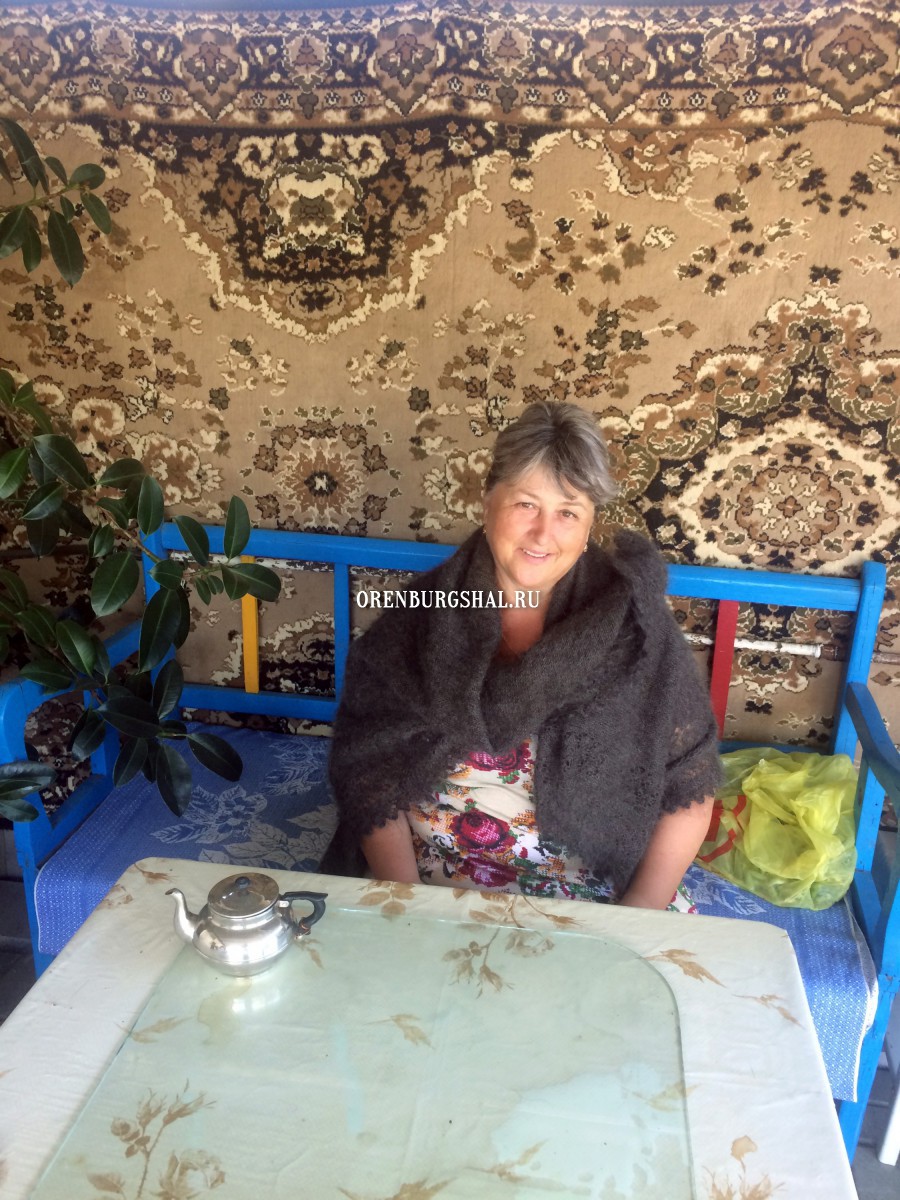


It was this shawl that absorbed the family traditions of several generations and witnessed all the historical milestones of their family. That very shawl still lies on a shelf in the wardrobe, neatly folded, waiting for its moment. And no one would think of throwing out this talisman; everyone knows that it will always unfailingly lend a warm helping hand, warm you, help you recover and lift your spirits. Such a shawl serves a family for decades and even a hundred years. And these are not our fabrications, but stories from life. Surely in your home too there is such a warm and caring friend, inherited from your grandmother or mother. Here in Orenburg there is no family without an old darned shawl that always comes to the rescue.


But unfortunately traditions are forgotten, lost under a layer of fashion trends, technologies and hobbies. Over the last 30 years our country has gone through many upheavals and changes. During this difficult time many traditions lost their thread of continuity. Something was erased from people's memory, generations changed, priorities changed. People began to forget about the shawl. Its place was taken by IKEA throws and Chinese bedspreads that can give you a decent jolt of static electricity. New economic conditions are crowding out the craft, leaving it only to connoisseurs.


But we just want to say that by buying a genuine Orenburg down shawl, you are not just buying an item with outstanding practical and artistic qualities — you are finding a friend who will be with you all your life. A friend who will warm both you and your children, a friend who will give warmth to your grandchildren, a friend about whom decades later people will say with love and reverence: this is grandmother's shawl, our talisman, our family treasure!