
About the craft
The Orenburg Down Shawl. Classic and Modern Patterns
As is well known, the pattern is a kind of "foundation" of the Orenburg down shawl. Any connoisseur of the craft will tell you that the pattern is first and foremost the basis of an item, since each one has its own knitting technique. It is the master's choice of pattern (or combination of patterns) that largely determines the entire subsequent making technology.
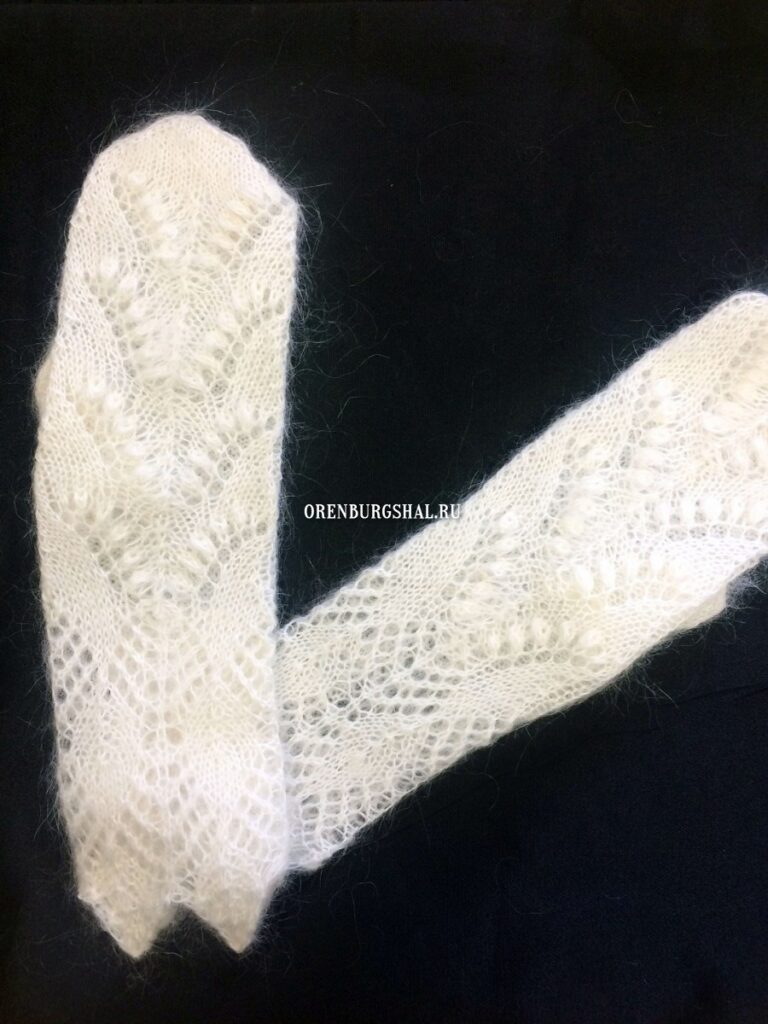
Several articles on our website have already been devoted to the classic patterns of down shawls. Now it should be mentioned that, just as the down-knitting craft itself has long since expanded beyond just classic warm shawls and gossamer shawls, the variety of knitting techniques and, accordingly, of the patterns of down items themselves is constantly growing. As in any craft, innovations are inevitable. Should they be accepted or not? This question still causes a lot of debate both among ordinary people and among specialists. And, of course, the main question: do items knitted using these very "innovations" remain truly Orenburg? Our opinion is yes, they do. However, there is plenty of debate about this today. Below we give a number of arguments, and each reader will be able to give a final answer for themselves.

The first thing to recall once again: the decisive factor in the question of Orenburg or not Orenburg is the place of origin of the item, or more specifically the origin of the material (in this case, Orenburg goat down), and secondarily the place where the item is knitted.
Second: originally only down shawls, warm shawls and gossamer shawls were called the "classics" of the down-knitting craft. But, as mentioned above, the craft is expanding: down stoles, , kerchiefs, , ponchos and pelerines are not essentially Orenburg classics, but they are also produced in the Orenburg region from Orenburg down, so most researchers today readily include all these items among the products of Orenburg down knitting.

Based on these arguments, we can move on to the patterns themselves and the question of their origin; as an example, the so-called "lilies of the valley" are practically identical to the designs of Haapsalu stoles.
So let us mention once again that any craft tends over time either to fade away or to expand in every direction. The patterns of down shawls (and indeed of any down items) are no exception. With the appearance of new patterns (and other trends) come debates: some local historians and experts on the craft do not recognise the "innovations" as classics, while others, on the contrary, see in them stages of development that cannot and should not be ignored.


As for the "lilies of the valley" pattern specifically: conservative researchers do not count this design among the "classic" ones. At the same time, it established itself in Orenburg down knitting quite a long time ago, taking root mainly on stoles, gossamer shawls and kerchiefs). The question of the origins of the design itself remains without a definite answer, as does the question of the origin of the techniques of most patterns, including the "classic" ones (craftswomen, in general, are often not very willing to share their secrets).

It is impossible to deny the similarity of the "lilies of the valley" pattern to the design that can be seen on Haapsalu items. Nor can one say for certain whether this particular pattern was "spotted" by one of the craftswomen, or whether any Orenburg knitter had been to Estonia. For this reason, finding out the original origin of the design and whether the pattern could have been copied is a thankless and impossible task. At the same time, it is indisputable that the "lilies of the valley" pattern established itself in Orenburg down knitting long ago (about 30 years ago) and can be seen on many items. Whether this is good or bad, and whether the "newfangled" pattern (in the opinion of a number of experts) will survive or fade away, only time will tell. At the moment the design appears one way or another on the items of Orenburg knitters, and items with this pattern are in demand.

Finally, it is worth mentioning once more: the primary and decisive factor of a genuine Orenburg down shawl is the place of origin of the item and of the material it is made from. At the same time, like any craft, Orenburg down knitting undergoes certain transformations from time to time (this applies to patterns too). Whether to accept "innovations", putting them on a par with the "classics", or not is a subjective question and everyone's personal matter. The debate about this continues to this day and is unlikely to end any time soon.
Need help choosing?
Tell us who you are choosing an item for and what matters to you — warmth, lightness, size or pattern. We will suggest suitable options.


